


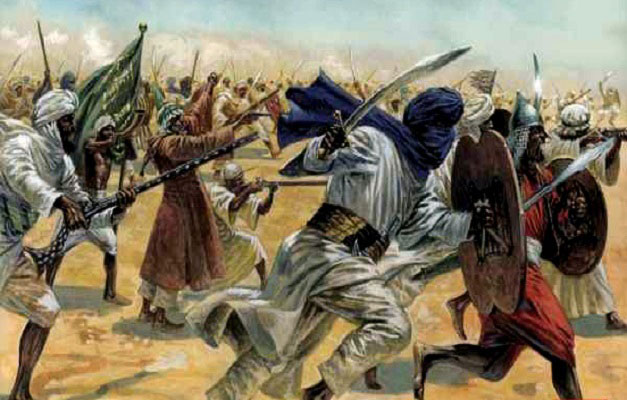
The Blitzkrieg of the Muslim armies in the first decades after the birth of their religion had such enduring results precisely because the Pagan populations in West- and Central-Asia had no choice (except death) but to convert. Whatever the converts’ own resentment, their children grew up as Muslims and gradually identified with this religion. Within a few generations the initial resistance against these forcible converions was forgotten, and these areas became heidenfrei (free from Pagans, cfr. judenfrei). In India it didn’t go like that, because the Muslims needed five centuries of attempts at invasion before they could catch hold of large parts of India, and even then they encountered endless resistance, so that they often had to settle for a compromise.
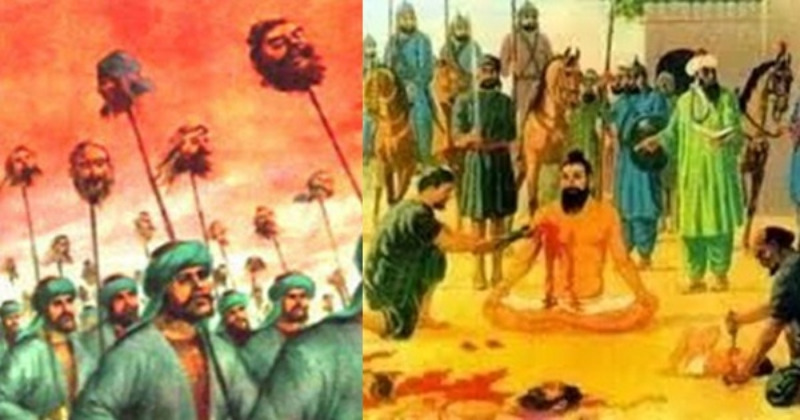
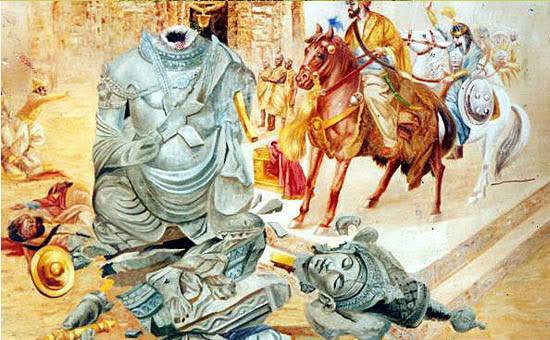
The Muslim conquests, down to the 16th century, were for the Hindus a pure struggle of life and death. Entire cities were burnt down and the populations massacred, with hundreds of thousands killed in every campaign, and similar numbers deported as slaves. Every new invader made (often literally) his hills of Hindus skulls. Thus, the conquest of Afghanistan in the year 1000 was followed by the annihilation of the Hindu population; the region is still called the Hindu Kush, i.e. Hindu slaughter. The Bahmani sultans (1347-1480) in central India made it a rule to kill 100,000 captives in a single day, and many more on other occasions. The conquest of the Vijayanagar empire in 1564 left the capital plus large areas of Karnataka depopulated. And so on.
As a contribution to research on the quantity of the Islamic crimes against humanity, we may mention Prof. K.S.Lal’s estimates about the population figures in medieval India (Growth of Muslim Population in India). According to his calculations, the Indian (subcontinent) population decreased by 80 million between 1000 (conquest of Afghanistan) and 1525 (end of Delhi Sultanate). More research is needed before we can settle for a quantitatively accurate evaluation of Muslim rule in India, but at least we know for sure that the term crime against humanity is not exaggerated.
But the Indian Pagans were far too numerous and never fully surrendered. What some call the Muslim period in Indian history, was in reality a continuous war of occupiers against resisters, in which the Muslim rulers were finally defeated in the 18th century. Against these rebellious Pagans the Muslim rulers preferred to avoid total confrontation, and to accept the compromise which the (in India dominant) Hanifite school of Islamic law made possible. Alone among the four Islamic law schools, the school of Hanifa gave Muslim rulers the right not to offer the Pagans the sole choice between death and conversion, but to allow them toleration as zimmis (protected ones) living under 20 humiliating conditions, and to collect the jizya (toleration tax) from them. Normally the zimmi status was only open to Jews and Christians (and even that concession was condemned by jurists of the Hanbalite school like lbn Taymiya), which explains why these communities have survived in Muslim countries while most other religions have not. On these conditions some of the higher Hindu castes could be found willing to collaborate, so that a more or less stable polity could be set up. Even then, the collaboration of the Rajputs with the Moghul rulers, or of the Kayasthas with the Nawab dynasty, one became a smooth arrangement when enlightened rulers like Akbar (whom orthodox Muslims consider an apostate) cancelled these humiliating conditions and the jizya tax.

-

🙏🏽Shubha Atal Jayanti 🙏🏽R
"Rag Rag Hindu Mera Parichaye" W.
-

Bagha Jatin – The Bengal Tiger Roa
“Amra morbo, jagat jagbe” We shall die.
-

Khudiram – The youngest martyr who
Khudiram Bose (also spelled Khudiram Basu or .
-

Char Dham Bill Repealed. Success for the
Hindu activists and the priests of the Char.
